Magic Carpet Made of Steel
Chapter No. 4
Previous ChapterA short history of the Union Pacific Railroad 4000 class “Bigboy” locomotive
By: A lot of people
Dedicated to: All of you steam enthusiasts, and the writers of this book. Though your enthusiasm, steam lives on.
The 4000 class, with the famous 4-8-8-4 wheel arrangement (or what we shall call from now on, “Bigboys”), could trace its roots to the Rocket, all other steam locomotives could, so that speaks little. One could more specifically trace it’s family history to 4 things: demand for larger and larger trains, a more efficient solution to the demand than a double-header, the Mallet type locomotives, and the need to have large, fast, long-distance trains up steep grades, one such example being a 2% grade.
At the turn of the century and throughout the early 1900s, demand, railroads, and trains, skyrocketed. For the longest time, the problem longer and heavier trains was met by a simple solution:double-heading. For those of you less acquainted with railroad jargon, this is when you couple 2 locomotives together. This, however, has a fundamental problem; you need to get more locomotives, which are not cheap, and are only useful for so long, and varies with demand, so when demand is low you’ll be paying to maintain locomotive doing squat.
This was solved by adding more wheels, allowing for more traction and power; 4-4-0s became 4-6-0s and 4-6-0s became 4-8. With larger and more wheels you needed larger pistons to power them, and therefore a larger boiler, with a larger tender and frame. With a larger smokebox and firebox, you needed to have 4 wheels to support them and lead the driving wheels (often simply called “drivers”,) into a curve, and another 4 to support the cab and firebox.
This also has a fundamental problem; as you add wheels, the locomotive becomes like a centipede with a stiff neck. Taking curves is harder and harder, and must be done slowly or be wider.
This problem also had a solution, one made by a certain Anatole Mallet. Anatole Mallet was a Swiss engineer, who one “day” (it took much longer than that, but you never really say that, so you?) took a 4-8-4, and, in layman's terms, then cut the frame in half, put on another set of pistons and driving rods, put a hinge in the middle, and put a larger boiler on it. He made a 4-4-4-4, and invented articulated locomotives, with a hinge in the middle, allowing to make tight turns much more easily.
If you aren’t noticing a pattern already, you should re-evaluate your IQ. This design had its problems as well. You see, it was steam efficient, having high-pressure steam going to the rear cylinders, and the expanding steam going to the front, and having larger pistons to accommodate the lower psi (pounds per square inch, for you Europeans reading about U.S. railroads). This the the source of the problem-Mallet locos, or Mollys, couldn’t go at very high speeds, as the counterweights on their front wheels would’ve beaten the tracks and made maintaining them far more expensive and time-consuming. There was also an imbalance between the front drivers and the rear ones, and could cause the front set to spin out of control and do nothing, a very wasteful and potentially dangerous situation.
The speed problem was particularly acute for UP, whom had shipments that might need to travel very long distances, perhaps 500 or more miles, and slow locomotives were thus very ineffective. So, during the 1920s, UP and other railroads reverted back to the older kind of locomotive, thus causing the 9000 class of locomotives, the largest non-articulate locos ever built, with a 4-12-4 wheel arrangement. They were very successful on the great plains, with very large turns in the track. However, in the Rockie Mountains, they were quite hindered by the sharp curves and much smaller tunnels and bridges. We needed a better solution.
Thus, in 1936 there was what seemed to be a final answer;the Challenger Class locomotive. It had a 4-6-6-4 wheel arrangement, and all 4 pistons were powered straight from the boiler, all high pressure, allowing for high speeds that
become commonplace on the UP that were unheard of for articulated locomotives on other railroads. But as WWII approached, and as the need for a locomotive that could pull longer and heavier trains up steep grades at high speeds without having to have a double-header was needed. Thus the Bigboy was born.
The Bigboy can go up to 80 mph, although it was never intended, and never was, run at that speed. At 35 mph, the maximum hp efficiency, a Bigboy has over 6,000 horsepower.
Although it was a rare thing for a steam locomotive to have anything but a monochromatic black paint job (and even then there was little color), and never at the cost of speed, efficiency or power (the reason being that steam locomotives are like tools; there is little reason to put an engraving or a coat of nice paint on it, and you would not do so if it made the tool less effective at what it did), the Bigboys carried a sense of majesty and beauty with them when run.
In 2013, UP announced it would re-acquire Bigboy No. 4014 to be restored to a fully functional level, in preparation for the 150th anniversary for completion of the first transcontinental railroad in the U.S. in 1869, the very thing that was the reason UP even exists.
For you Europeans
PSI-Pounds per square inch.
Ton (t)-2,000 pounds
Pound-0.453592 Kilograms
1 foot- 30cm
1 mile-5,280 feet
mph-miles per hour.
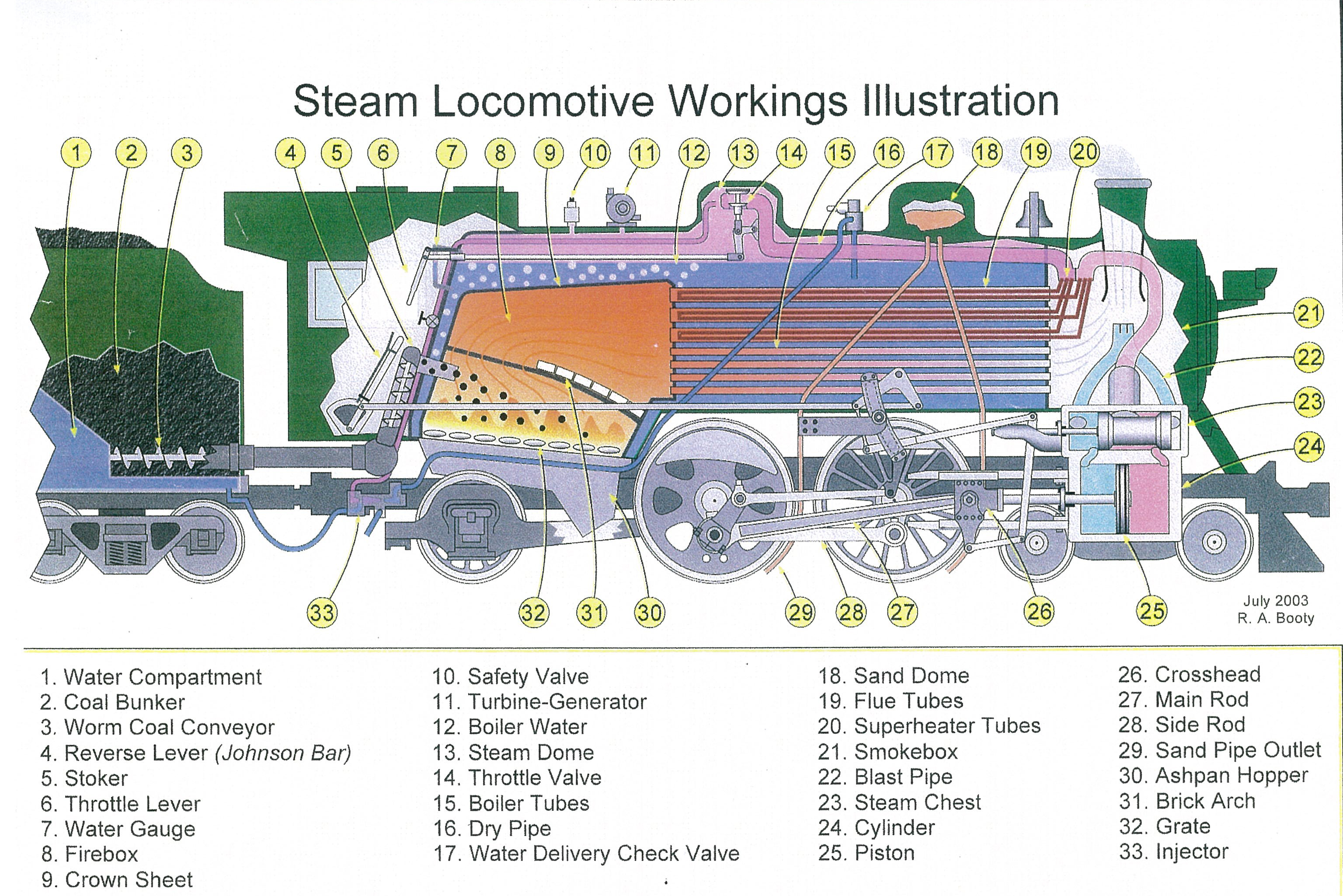
[url=http://coloradorailroadmuseum.org/wp-content/uploads/2015/07/Steam-Engine-Cutaway.jpg ]For those of you less acquainted with the workings of a steam locomotive[/url]